Bluetooth & BLE
The phone stays in the pocket.
Bluetooth Low Energy turns a phone into a proximity credential. The reader advertises, the phone answers with a rotating token, and the door opens without anything being taken out, unlocked or presented.

People forget badges. Nobody forgets their phone. Bluetooth Low Energy turns that fact into a credential — one that costs nothing to issue, nothing to replace, and can be revoked from a desk in under a second.
How it works
The detail that decides whether this survives contact with a real building.
- Range control
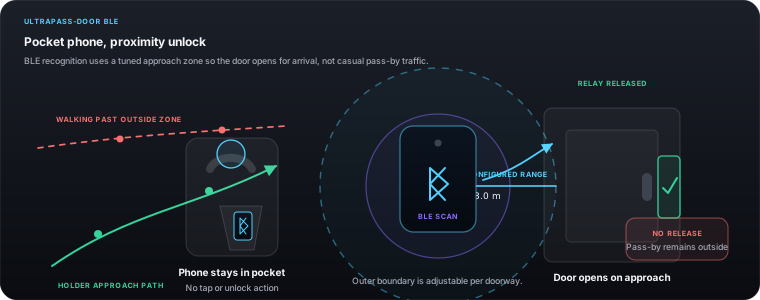
- Signal-strength threshold is set per door, so a lobby reader does not open for someone walking past outside
- Token
- A short-lived rotating token, not a static identifier that can be captured and replayed
- Intent
- Choose passive proximity or an explicit tap-to-unlock in the app, per door
- Battery
- Background operation; no need to hold the app open
- Fallback
- A flat phone battery falls back to QR, card or PIN on the same reader

Range is a setting, not an accident
The signal-strength threshold is configured per door. A turnstile can be set to a few centimetres so it only responds to a deliberate approach, while an accessible side entrance can be set to a couple of metres so the door is already open by the time someone reaches it.
A rotating token, not a static ID
What the phone presents changes. A static identifier broadcast over the air is a credential anyone with an antenna can capture and replay — so the phone answers a challenge with a short-lived token instead, and yesterday's capture is worthless.
Passive or deliberate, per door
Some doors should open as you walk up. Others should require you to tap a button, because a door that opens whenever a phone drifts near it is a door that opens for people walking past in the corridor. This is a per-door choice.
It runs in the background
The app does not need to be open, foregrounded, or woken by the user. Battery draw is measured in single-digit percentages per day, because BLE was designed for exactly this duty cycle.
A dead battery is not a lockout
The same panel that reads the phone reads a card, a QR and a PIN. A flat phone is an inconvenience, not an incident.
Issue and revoke in seconds
There is no card to print, courier or collect. Granting phone access to a new contractor is a console action, and withdrawing it on their last day is another one.
Where this fits
Turnstiles, main entrances, accessible doors, and staff who carry a phone but resist a badge.
Because every channel resolves to the same holder record, this does not have to be the only way in. A person can hold this alongside a card, a PIN and a plate, and the audit trail still reads as one identity.
Questions about bluetooth & ble
Do I have to open an app to get through the door?
Not unless you want to. Each door is configured either for passive proximity, where the phone responds in the background, or for deliberate tap-to-unlock in the app. Most sites use passive on main entrances and deliberate on sensitive doors.
Can someone capture my Bluetooth signal and replay it?
The phone presents a short-lived rotating token in response to a challenge, not a fixed identifier, so a captured exchange does not open the door later.
Will the door open for someone walking past outside?
Only if the range is set that wide. Signal-strength thresholds are configured per door specifically so a lobby reader does not respond to the pavement.
How much battery does this use?
BLE is designed for continuous low-power operation. Background use is typically a low single-digit percentage of a phone battery per day.
The other ways in
One access list, one console, one audit trail — whichever of these a person happens to be carrying.
Face Recognition
Walk up, look up, walk through.
UltraPASS-VehicleVehicle Plate Recognition
The car is the credential.
UltraPASS-BioBiometric Access
A credential that cannot be lent.
UltraPASS-DoorNFC, MIFARE & HID Cards
Keep the cards you already issued.
UltraPASS-DoorDynamic QR Codes
A key that expires while you watch it.
UltraPASS-DoorBarcodes & Static Passes
For everything already printed.
UltraPASS-DoorPIN & Keypad
The fallback that always works.