The protocol landscape, honestly labelled
There are well over a hundred communication standards in active service across building automation, metering, IoT, industrial plant, security and networking. A vendor page that lists thirty of them under the heading “supported” is not helping you specify anything. This page lists 87 of them, groups them by the job they do, and states plainly which ones xSERVA addresses, which are in designed scope, and which it does not touch at all.
It is deliberately more useful than it is flattering.
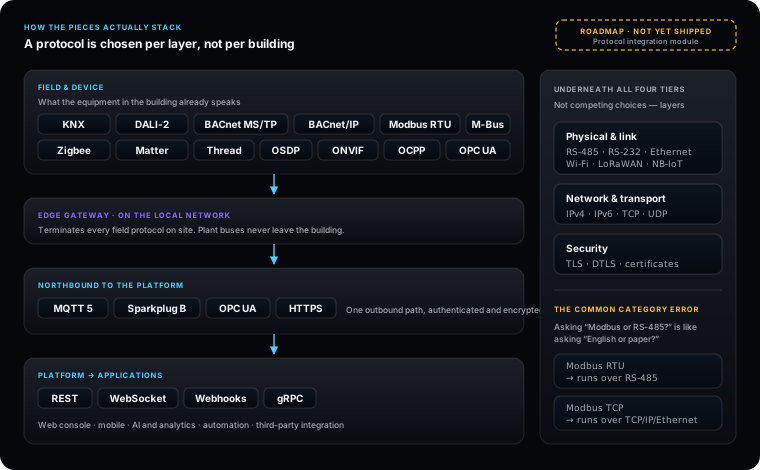
Ask About A Specific ProtocolProtocols are chosen per layer, not per building
The single most expensive misunderstanding at specification stage is treating every protocol as a competing choice. They are not. A building runs several at once because they answer different questions, at different levels, over different physical media — and a good number of the names on this page are not application protocols at all, but the transports underneath them.
The practical shape is four tiers. At field and device level the equipment speaks whatever its manufacturer built it to speak: KNX, DALI-2, BACnet, Modbus, M-Bus, Zigbee, OSDP, ONVIF, OCPP. An edge gateway on the local network terminates all of it, so plant buses that were never designed for internet exposure do not get any. Northbound from that gateway runs a single authenticated, encrypted path — MQTT 5 with Sparkplug B, OPC UA, or HTTPS. Above it the platform exposes REST, WebSocket, webhooks and gRPC to the web console, the mobile app, analytics, and anything a customer wants to build.
How to read the status on every row
Shipping today means it is in the product now. That is a short list, and it is short on purpose.
In designed scope means it sits inside the designed scope of the xSERVA protocol integration module. That module is on the roadmap and ships nothing today. A protocol marked this way is a design intention, not a capability you can deploy, and it should not be written into a tender as a present-tense requirement without asking us for the current status first.
Landscape only means the protocol is real, relevant and in service somewhere — and xSERVA does not address it and has no current plan to. It is listed because knowing what a platform does not do is worth more at specification stage than another page of claims.
Underlying layer means it is a transport, network or security layer that other protocols run on top of, rather than something you choose instead of them.

Building automation and control
The protocols that govern HVAC, lighting, blinds and room control. This is the centre of gravity for a BAS or BMS, and where the largest installed base sits.
| Protocol | What it is for | Status in xSERVA |
|---|---|---|
| KNX | Room and building automation over twisted pair, IP or RF. ISO/IEC 14543. Addressed by group address and datapoint type. | In designed scope |
| KNXnet/IP | KNX tunnelled or routed over IP, which is how a modern KNX line reaches anything beyond its own bus. | In designed scope |
| KNX Secure | Authentication and encryption for KNX at the telegram level, covering both IP Secure and Data Secure. | In designed scope |
| BACnet/IP | The dominant protocol for commercial HVAC and plant, addressed at object and property level rather than as a flat point count. | In designed scope |
| BACnet MS/TP | BACnet over an RS-485 serial bus, still the most common way field-level unitary controllers such as VAV boxes are reached. | In designed scope |
| BACnet/SC | BACnet Secure Connect: TLS-based, firewall-friendly transport that removes the need to route raw BACnet/IP across a network. | In designed scope |
| DALI | Digital Addressable Lighting Interface. Per-luminaire addressing and dimming on a two-wire bus. | Landscape only |
| DALI-2 | The current DALI generation, adding certified control devices, sensors and input devices rather than ballasts alone. | In designed scope |
| D4i | DALI-2 extended for intra-luminaire data — energy reporting and diagnostics from the driver itself. | Landscape only |
| LonWorks / LonTalk | An older building control standard still present in a large installed base, particularly in plant fitted out in the 1990s and 2000s. | Landscape only |
| EnOcean | Batteryless wireless sensors and switches harvesting energy from the act of pressing them. Common in retrofit where cabling is not viable. | Landscape only |
| DMX512 | Lighting control for entertainment and architectural feature lighting. Not a building control protocol despite the overlap. | Landscape only |
| Art-Net | DMX512 encapsulated over IP for larger architectural lighting installations. | Landscape only |
| sACN / E1.31 | Streaming ACN, the other common way DMX universes are carried over an IP network. | Landscape only |
Metering, energy and power
Where the numbers behind an energy strategy or an ESG report actually originate. Almost every building already has more metering than its software reads.
| Protocol | What it is for | Status in xSERVA |
|---|---|---|
| Modbus RTU | Serial Modbus, overwhelmingly the protocol spoken by meters, generators, VFDs and packaged plant. Register-level addressing with per-device typing. | In designed scope |
| Modbus TCP | Modbus framed over TCP/IP. The same register model, reached over Ethernet instead of RS-485. | In designed scope |
| M-Bus | Meter-Bus, EN 13757. Purpose-built for utility metering — heat, water, gas and electricity — on a two-wire bus. | In designed scope |
| Wireless M-Bus | The radio variant of M-Bus, widely used where meters sit in risers or apartments that cannot be practically wired. | Landscape only |
| DLMS/COSEM | The international standard for smart electricity metering and the data model behind most utility-grade meters. | In designed scope |
| SunSpec Modbus | A common Modbus register map for inverters, batteries and other energy assets, so solar plant does not need a bespoke map per vendor. | Landscape only |
| IEC 61850 | Substation automation. Relevant where a site owns its own HV switchgear or has a private substation. | Landscape only |
| IEC 60870-5-104 | Utility SCADA telecontrol over TCP/IP, seen at the boundary between a large site and its distribution network operator. | Landscape only |
| DNP3 | Distributed Network Protocol, common in utility and water SCADA in some regions. | Landscape only |
IoT messaging and device connectivity
How a sensor fleet reports, and how the edge talks to the platform. This is the layer that has changed most in the last decade.
| Protocol | What it is for | Status in xSERVA |
|---|---|---|
| MQTT 3.1.1 | The publish-subscribe messaging protocol that became the default for IoT telemetry. | Landscape only |
| MQTT 5.0 | The current version, adding reason codes, message expiry, shared subscriptions and user properties. Addressed at topic and payload level. | In designed scope |
| MQTT-SN | MQTT adapted for constrained and non-TCP networks such as ZigBee or raw radio links. | Landscape only |
| Sparkplug B | A defined topic namespace and payload for MQTT, which is what turns a loose broker into something with a known state model and birth/death certificates. | In designed scope |
| CoAP | A compact request/response protocol for very constrained devices, roughly REST semantics over UDP. | Landscape only |
| LwM2M | Device management over CoAP — provisioning, firmware update and diagnostics rather than telemetry. | Landscape only |
| AMQP | Enterprise message queuing, more common between back-end systems than between devices. | Landscape only |
| DDS | A real-time data distribution standard used where deterministic latency matters more than simplicity. | Landscape only |
| Zigbee | A low-power mesh widely deployed in lighting and sensing. | In designed scope |
| Thread | IPv6 low-power mesh networking, the transport underneath much of Matter. | In designed scope |
| Matter | An application-layer interoperability standard intended to end per-vendor smart device silos. | In designed scope |
| Z-Wave | A sub-GHz mesh with a large residential installed base. | Landscape only |
| Bluetooth Low Energy | Short-range, low-power radio used for sensors, beacons, credentials and commissioning. | In designed scope |
| Bluetooth Mesh | BLE extended into a many-to-many mesh, used at scale in lighting. | Landscape only |
| Wi-SUN | A field area mesh used for utility and smart city infrastructure. | Landscape only |
Industrial and process automation
Present wherever a building contains manufacturing, a process plant, or serious mechanical infrastructure. Mostly outside a commercial BMS, and important to know is outside it.
| Protocol | What it is for | Status in xSERVA |
|---|---|---|
| OPC UA | A platform-independent, secure-by-design interoperability standard with a rich information model. The usual bridge between plant and IT. | In designed scope |
| OPC UA PubSub | The publish-subscribe extension to OPC UA, for cyclic real-time data rather than client/server polling. | Landscape only |
| PROFINET | Industrial Ethernet for automation, dominant in some manufacturing estates. | Landscape only |
| PROFIBUS | The serial fieldbus that preceded PROFINET, still widely installed. | Landscape only |
| EtherNet/IP | CIP over Ethernet, common in North American automation. | Landscape only |
| EtherCAT | High-speed deterministic Ethernet for motion control. | Landscape only |
| CAN, CAN FD, CANopen | Embedded and machine-level buses. CANopen in particular appears inside packaged plant. | Landscape only |
| J1939 | The CAN application layer used by engines and heavy machinery, including standby generator sets. | Landscape only |
| IO-Link, IO-Link Wireless | Point-to-point smart sensor and actuator communication below the fieldbus. | Landscape only |
| HART, WirelessHART | Digital signalling layered over 4–20 mA process instrumentation. | Landscape only |
| FOUNDATION Fieldbus | A process control fieldbus for continuous plant. | Landscape only |
| DeviceNet, AS-Interface, POWERLINK, Sercos III | Further industrial buses encountered in existing plant. | Landscape only |
Security, video, access and EV
The subsystems that most often arrive as separate platforms with separate logins, and the reason a building ends up with five of them.
| Protocol | What it is for | Status in xSERVA |
|---|---|---|
| OSDP | Open Supervised Device Protocol. Encrypted, supervised, bidirectional reader communication, and the modern replacement for Wiegand. | In designed scope |
| Wiegand | The legacy reader interface: unencrypted, unsupervised, one-way. Still enormous in installed base, which is why it cannot simply be ignored. | Shipping today |
| ONVIF | The interoperability standard for IP cameras and video devices, including Profile T for modern video. | In designed scope |
| RTSP | The control protocol for establishing and steering an IP video stream. | In designed scope |
| RTP / RTCP | The transport that actually carries audio and video once RTSP has negotiated the session. | Landscape only |
| SIP | Session Initiation Protocol, behind IP intercoms and door stations. | Landscape only |
| NFC | Near-field communication for credentials, identification and commissioning. | Shipping today |
| RFID | Identification for credentials and asset tracking, from 125 kHz proximity through 13.56 MHz MIFARE and DESFire. | Shipping today |
| UWB | Ultra-wideband, used where precise ranging is needed rather than mere proximity. | Landscape only |
| OCPP 1.6 / 2.0.1 / 2.1 | Open Charge Point Protocol, between an EV charger and its management system. 1.6 remains the field majority; 2.0.1 and 2.1 are the current generations. | In designed scope |
| ISO 15118 | Communication between the vehicle and the charger, including Plug and Charge. | Landscape only |
| OCPI | Roaming and interoperability between EV charging networks. | Landscape only |
Platform, API and application
How the platform is reached by a browser, a phone, a BI tool or another vendor’s system. Everything here is above the building, not in it.
| Protocol | What it is for | Status in xSERVA |
|---|---|---|
| HTTPS | The transport for every API call and every page of the console. | Shipping today |
| REST | The resource-oriented API style the platform exposes. | In designed scope |
| WebSocket | Persistent bidirectional connection for live dashboards and event streams. | In designed scope |
| Webhooks | Outbound event delivery to a customer system, so integration does not require polling. | In designed scope |
| Server-Sent Events | One-way live updates from server to browser where a full WebSocket is not warranted. | Landscape only |
| gRPC | Efficient service-to-service RPC, relevant for internal and partner integration. | Landscape only |
| GraphQL | A query language for APIs where clients need to shape their own responses. | Landscape only |
| SOAP | Still encountered when integrating with older enterprise and government systems. | Landscape only |
| WebRTC | Real-time media and data in the browser, relevant to intercom and live video. | Landscape only |
Transport, networking and security layers
These are not alternatives to KNX, BACnet, Modbus or MQTT. They sit underneath them. Modbus RTU runs over RS-485; Modbus TCP runs over TCP, IP and Ethernet; MQTT runs over TCP/IP carried by Ethernet, Wi-Fi or cellular. Choosing between a protocol and its transport is a category error, and it is the one most likely to appear in a specification.
| Protocol | What it is for | Status in xSERVA |
|---|---|---|
| RS-485 | The multidrop serial physical layer under BACnet MS/TP, Modbus RTU and much else. | Underlying layer |
| RS-422 / RS-232 | Point-to-point serial, still present on older plant and on service ports. | Underlying layer |
| Ethernet / IEEE 802.3 | The wired network everything above eventually rides on. | Underlying layer |
| Wi-Fi | Wireless IP connectivity, including 802.11ah HaLow for long-range low-power devices. | Underlying layer |
| LoRaWAN | Long-range, low-power wide-area radio for sparse sensing across a site. | Underlying layer |
| NB-IoT / LTE-M / 4G / 5G | Cellular connectivity, used where a site has no usable fixed network. | Underlying layer |
| TCP / UDP | Reliable and lightweight transport respectively. | Underlying layer |
| IPv4 / IPv6 | Addressing. IPv6 matters increasingly at device level, notably under Thread. | Underlying layer |
| TLS / DTLS | Encryption and authentication for TCP and UDP respectively. Underneath BACnet/SC, MQTT over TLS, HTTPS and OPC UA. | Underlying layer |
| QUIC / HTTP/2 / HTTP/3 | Modern web transport. | Underlying layer |
| DNS, mDNS, DNS-SD | Name resolution and local service discovery, which is how devices find each other on a commissioning network. | Underlying layer |
| DHCP | Automatic address assignment. | Underlying layer |
| NTP / PTP (IEEE 1588) | Time synchronisation. Without it, correlating an alarm with a meter reading is guesswork; PTP is used where sub-millisecond accuracy is needed. | Underlying layer |
| SNMP | Monitoring of network and infrastructure devices such as switches and UPS. | Landscape only |
| SSH / SFTP | Secure remote administration and file transfer. | Underlying layer |
| Syslog | Log shipping to a central collector or SIEM. | Landscape only |
If you are specifying a building right now
Most commercial estates reduce to a short list, and it is shorter than this page suggests: BACnet for HVAC and plant, KNX or DALI-2 for lighting and blinds, Modbus and M-Bus for metering, MQTT for any sensor overlay added after handover, and ONVIF and OSDP where video and access control are in scope. Add OCPP if there is EV charging and OPC UA if the site has industrial plant behind it.
Everything else on this page is either specific to industry, specific to utilities, or a layer underneath one of those — worth recognising in a document, not worth requiring in one.
Four of them have a deeper explainer here: BACnet, KNX, MQTT and Modbus, with a side-by-side comparison and a glossary of the terms used across all of them.
Frequently asked questions
Does xSERVA support all of these protocols?
No, and no platform does. This page is a reference to the landscape, not a capability list. Each entry is marked: "Shipping today" means it is in the product now, "In designed scope" means it is inside the designed scope of the protocol integration module — which is a roadmap module that ships nothing today — and "Landscape only" means xSERVA does not address it and has no current plan to. Ask us for the status of a specific protocol before writing it into a specification.
Why are RS-485, Ethernet and TLS listed separately?
Because they are layers, not competing protocols. Modbus RTU runs over RS-485 and Modbus TCP runs over TCP, IP and Ethernet — it is the same Modbus register model on a different transport. Treating a transport as an alternative to an application protocol is the most common category error in building specifications, and it produces requirements that cannot be satisfied as written.
Which protocols actually matter for a typical commercial building?
In most commercial estates the short list is BACnet for HVAC and plant, KNX or DALI-2 for lighting and blinds, Modbus and M-Bus for metering, MQTT for any modern sensor overlay, and ONVIF and OSDP where video and access control are in scope. Everything else on this page is either specific to industry, specific to utilities, or a layer underneath one of those.
Are KNX, DALI-2, OPC UA and OCPP still current standards?
Yes. All four are under active development with current published specifications — KNX Secure, DALI-2 and D4i, OPC UA PubSub, and OCPP 2.0.1 and 2.1 are all recent additions to their respective standards. None of them is a legacy technology, which is a common misreading when a standard has been in service for decades.
What is an edge gateway and why does it sit in the middle?
A field protocol is designed for a local, trusted network and mostly has no answer for authentication, encryption or internet exposure. An edge gateway terminates those protocols on site and speaks one authenticated, encrypted path northbound — MQTT with TLS, OPC UA, or HTTPS. That is what keeps a plant bus off the public internet while still allowing the platform to see it.