Eight ways through a door, compared honestly
There is no single best credential — there is a right credential for a given door, a given crowd and a given consequence of getting it wrong. This table is the shortest way to pick.
| Credential | Time At The Door | Read Range | Assurance | Works Offline | Hands-Free |
|---|---|---|---|---|---|
| Face Recognition | under 0.5 s | 0.3 – 1.5 m | High | Yes | Yes |
| Vehicle Plate Recognition | under 1 s | 2 – 8 m | Medium | Yes | Yes |
| Biometric Access | under 1 s | contact | Highest | Yes | No |
| NFC, MIFARE & HID Cards | under 0.3 s | 0 – 5 cm | Medium | Yes | No |
| Bluetooth & BLE | under 1 s | 0.1 – 10 m, tunable | High | Yes | Yes |
| Dynamic QR Codes | under 0.5 s | held to the scanner | High | Yes | No |
| Barcodes & Static Passes | under 0.5 s | held to the scanner | Basic | Yes | No |
| PIN & Keypad | as fast as typing | at the panel | Basic | Yes | No |
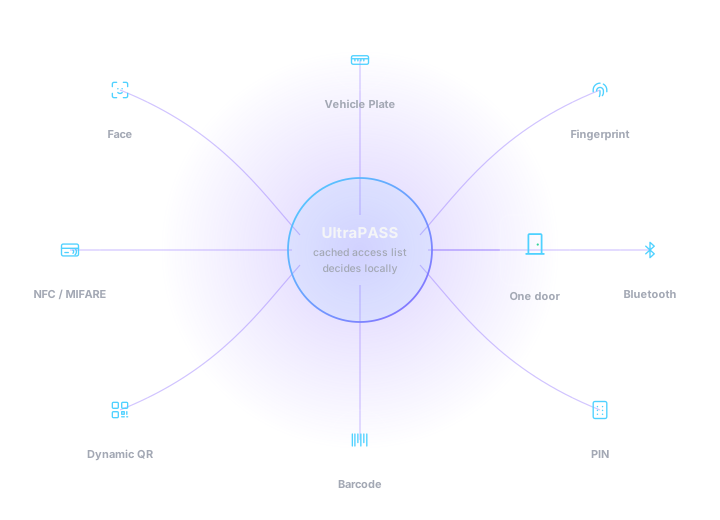
Where each one belongs
The same eight rows, read as recommendations instead of specifications.
Face Recognition
Staff entrances, lobbies, lift lobbies, and any door where hands are usually full.
Vehicle Plate Recognition
Car-park barriers, loading bays, gated communities, and fleet yards.
Biometric Access
Server rooms, cash rooms, pharmacy stores, and any door with an audit obligation.
NFC, MIFARE & HID Cards
Existing sites, large headcounts, contractors, and anywhere a physical badge is already policy.
Bluetooth & BLE
Turnstiles, main entrances, accessible doors, and staff who carry a phone but resist a badge.
Dynamic QR Codes
Visitors, contractors, tenants, delivery drivers, and anyone who should not be issued a card.
Barcodes & Static Passes
Events, printed visitor badges, schools, and short-lived one-day access.
PIN & Keypad
Back-of-house doors, second-factor pairing, and a fallback on every reader.
A note on assurance ratings
“Basic” here does not mean broken. It means the credential can be copied or shared without much effort — a static barcode can be photographed, a short PIN can be shoulder-surfed, and MIFARE Classic can be cloned. That is fine for a stationery cupboard and wrong for a cash room. The point of running all eight on one platform is that you get to make that judgement door by door instead of once for the whole building.
Layer them where it matters
Assurance is not only a property of the credential. A basic credential behind a second factor, a schedule and an anti-passback rule can be stronger in practice than a high-assurance credential used carelessly on a door that is propped open every afternoon.
Frequently asked
Which credential type should I choose?
Usually more than one. Match the credential to the consequence of the door: biometrics or DESFire cards on high-value rooms, face or BLE on staff entrances where throughput matters, dynamic QR for visitors and contractors, ANPR at barriers, and PIN as a fallback on everything.
Can different doors use different credentials?
Yes. Credential policy is set per door, not per site. A main entrance can accept face, card, phone and QR while a server room accepts only fingerprint plus PIN.
Do all credential types work offline?
Yes. Every channel is matched on the reader against a locally held access list, so an internet outage does not lock anyone out or let anyone in who should not be.
Can one person hold several credential types at once?
Yes, and it is the normal case. A holder record can carry a face template, a card UID, a PIN, a dynamic QR entitlement and a vehicle plate simultaneously, and every entry resolves to the same identity in the audit trail.
Try all eight in the browser
The interactive lab lets you present each credential to a simulated reader and watch how the decision differs.